

Routine Observations of Hot Springs and Deep Groundwater in the Northeastern Noto Peninsula Reveal the Origin of Deep Fluid Flow and Variations Prior to the 2024 Noto Peninsula Earthquake
Feb 24, 2026
Professor Yoshihiro Hiramatsu and Professor Tomoaki Morishita of the Faculty of Geosciences and Civil Engineering, Institute of Science and Engineering, Kanazawa University, in collaboration with Assistant Professor Takanori Kagoshima of the Department of Science, Faculty of Academic Research, Toyama University, and a research team including Director Yuji Sano of the International Marine Core Research Institute, Kochi University, and the University of Tokyo, conducted routine observations of hot springs and deep groundwater in the northeastern Noto Peninsula, revealing the origin of deep fluids and the fluctuations that preceded the 2024 Noto Peninsula earthquake.
To understand the origin of deep fluids and the phenomena that occurred underground in the northeastern Noto Peninsula following earthquake swarms, we monitored temporal variations in the ³He/⁴He ratio (*1) in hot springs in the area and analyzed the results in combination with seismic wave tomography (*2).
From the results obtained, it is expected that the research method combining routine observations of ³He/⁴He ratios in hot springs and deep groundwater with seismic tomography will be useful for analyzing subsurface structure and clarifying the origin and behavior of fluids related to seismic activities.
This research was supported by Grants-in-Aid for Scientific Research (Special Research Promotion Grant) 22K19949 and 23K17482, and Kyoto University Disaster Prevention Research Institute Collaborative Research 2023GC–07, with Professor Yoshihiro Hiramatsu as the principal investigator. Professor Yoshihiro Hiramatsu (Seismology) and Professor Tomoaki Morishita (Petrology) contributed to the planning and sampling of this research.
The results of this research were published in the international journal “Nature Communications“ on November 26, 2025.
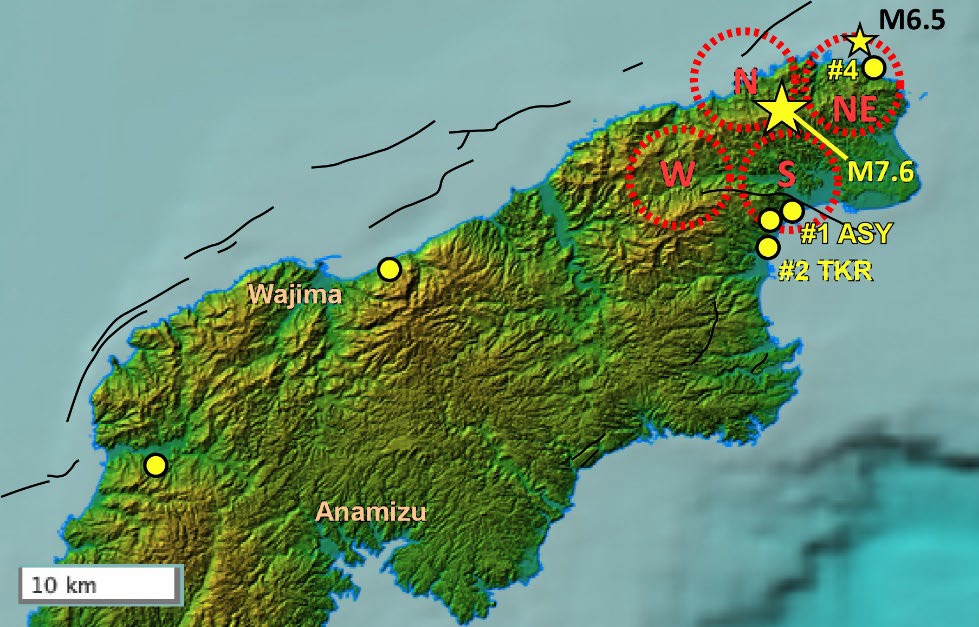 Figure: Survey Locations
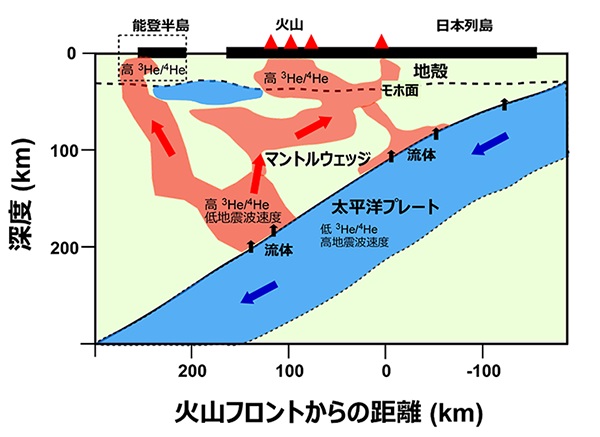 Figure : Schematic diagram of the subsurface structure of the Japanese Islands.
The low-velocity areas shown in red are considered soft and material can rise.
【Glossary】
*1: ³He/⁴He ratio
This is the stable isotope ratio of helium. Helium has two stable isotopes with mass numbers of 3 and 4. ³He is the primordial component that was introduced into the solid earth from outer space during the formation of the earth, and ⁴He is the alpha particle produced by the radioactive decay of uranium and thorium. Since the ³He/⁴He ratio is high in the mantle and low in the crust, the origin of helium can be analyzed by measuring the ³He/⁴He ratio in hot springs and groundwater.
*2 Seismic tomography
Seismic tomography is a method of estimating subsurface seismic wave velocity structure using seismic wave arrival time data. Because seismic wave velocity varies depending on the density of materials and other factors, this method is useful for investigating the structure of the subsurface.
Click here to see the press release【Japanese only】
Journal:Nature Communications
Researchers’ Information: Yoshihiro Hiramatsu
Researchers’ Information: Tomoaki Morishita