

Development of Semiconducting Coordination Polymers that Melt by Introducing Flexible Long Alkyl Chains — Expectations for a Dramatic Improvement in the Processability of PCP/MOF Materials
Apr 06, 2026
A joint research group consisting of Assistant Professor Takuya Kurihara of the Faculty of Chemistry, Institute of Science and Engineering, Kanazawa University, Assistant Professor Ryohei Akiyoshi of Kwansei Gakuin University, Professor Daisuke Tanaka, Mr. Shunya Takamura (second-year master’s student, Graduate School of Science and Engineering), Professor Kazuyoshi Ogasawara, and researchers from the Graduate School of Engineering, University of Osaka, Kindai University, and the Japan Synchrotron Radiation Research Institute (JASRI) has succeeded in developing a meltable semiconductor material by introducing soft alkyl groups into a semiconducting coordination polymer(*1).
Organic–inorganic composite materials composed of metals and organic bridging ligands are called porous coordination polymers/metal–organic frameworks (PCPs/MOFs) or coordination polymers (CPs), and they are crystalline solid materials that play a central role in modern solid-state chemistry and materials science. While previous research has focused on periodic structures in the crystalline state—such as porosity (the presence of pores within the crystal structure)—MOFs and CPs that exhibit melting or liquid-crystalline behavior have recently attracted attention from the viewpoint of formability and processability. However, many conventional MOFs and CPs thermally decompose before melting when heated.
In this study, by introducing flexible long-chain alkyl groups into a sulfur-containing CP (*2), which is expected to serve as a next-generation semiconductor material, the research group succeeded in imparting melting and liquid-crystalline properties while maintaining semiconducting characteristics. Assistant Professor Kurihara evaluated the structure around the metal center and clarified the correlation between the structure and semiconducting properties. This achievement is expected to lead to a dramatic improvement in the processability of MOFs and CPs—an issue that has long been recognized—and to contribute to their practical application in optoelectronic devices.
The results of this research were published in the German chemical journal “Angewandte Chemie International Edition“ on February 9, 2026 (Japan time).
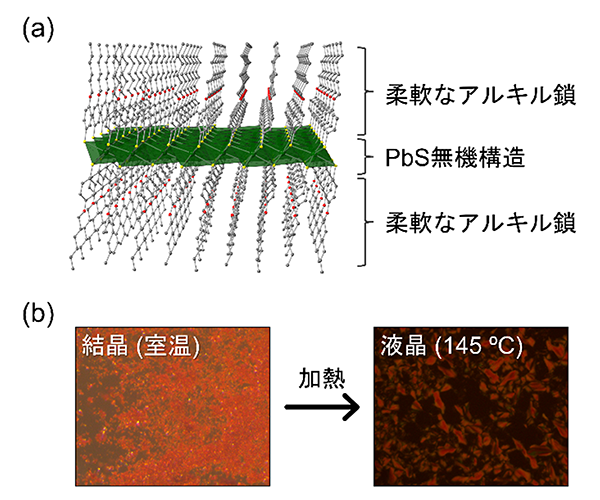
Figure: Crystal structure (a) and phase-transition behavior (b) of KGF‑34(C6)
【Glossary】
*1 Semiconductor coordination polymers
Coordination polymers that exhibit intermediate electrical properties between conductors, which conduct electricity well, and insulators, which conduct very little electricity.
*2 Sulfur-containing CP
A coordination polymer in which sulfur serves as the coordinating atom, exhibiting excellent semiconducting properties derived from metal–sulfur bonding.
Click here to see the press release【Japanese only】
Journal : Angewandte Chemie International Edition
Researcher Information : Takuya Kurihara