

Particulate thiol distribution along a meridional transect in the western North Pacific
Jun 08, 2026
***The following content was professionally authored by a designated science writer and not produced through auto-translation.***
This study was conducted by a team consisting of a research group led by Prof. Wong, Kanazawa University, and a research group led by Prof. Obata, the University of Tokyo, also in collaboration with a scientist of Nagasaki University. The researchers analyzed seawater samples collected along the GEOTRACES GP22(*2) transect across the western North Pacific and revealed for the first time the wide distribution of two particulate thiols, cysteine (p-Cys) and glutathione (p–GSH)(*1). As a result of the analysis, the indices of particulate thiols normalized to chlorophyll a (p-Cys/Chl-a, p-GSH/Chl-a) were found to vary significantly depending on the water mass, and clear geographical patterns were confirmed with the lowest values in the Pacific Subarctic Upper Water (PSUW) with high values also in the North Equatorial Counter Current (NECC), North Pacific Central Water (NPCW), and North Pacific Transition Zone (NPTZ), reflecting the biological community composition and water mass characteristics. In particular, p-GSH/Chl-a was significantly high in NPCW, suggesting that, in addition to the metal stress from the strong light environment and atmospheric deposition, non-living particulates also contribute.
Furthermore, the results of culture experiments in the laboratory using the marine cyanobacterium Synechococcus sp. and the diatom Thalassiosira nordenskioeldii confirmed that phytoplankton were the major source of particulate thiols and that p-GSH derived from Synechococcus sp. significantly increased under Cu stress conditions.
The results reveal that some of the regional differences found in the observation areas can be explained by the physiological responses of phytoplankton. Furthermore, the significantly high level of p-GSH/Chl-a in NPCW cannot be explained solely by an origin from living cells; rather, it is considered that particulates derived from dead phytoplankton, which contain “preformed” glutathione, a form that can remain relatively intact even after chlorophyll has already decomposed, are likely to be a major contributor.
These results indicate that the distribution of particulate thiols in the ocean is formed by the overlap of multiple biogeochemical processes such as the composition of phytoplankton communities, light and metal stress, and the production and decomposition of particulates.
The results of this research were published in the international journal “Science of the Total Environment“ on December 15, 2025 (European time).
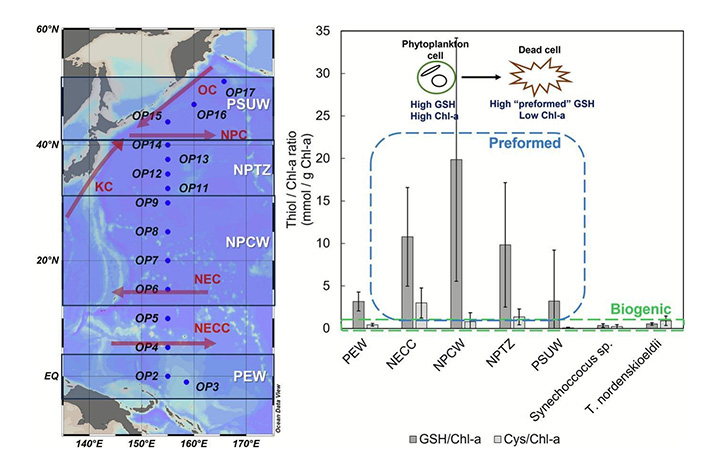
Overview of This Study:Samplings were carried out in the surface waters at stations OP3-OP17 (left). Average particulate thiol concentrations, normalized to chlorophyll a concentrations in each water mass:, i.e. PEW (Pacific Equatorial Water), NECC (North Equatorial Counter Current), NPCW (North Pacific Central Water), NPTZ (North Pacific Transition Zone), and PSUW (Pacific Subarctic Upper Water), were compared with those measured in the cells of two phytoplankton species, Samplings were carried out in the surface waters at stations OP3-OP17 (left). Average particulate thiol concentrations, normalized to chlorophyll a concentrations in each water mass:, i.e. PEW (Pacific Equatorial Water), NECC (North Equatorial Counter Current), NPCW (North Pacific Central Water), NPTZ (North Pacific Transition Zone), and PSUW (Pacific Subarctic Upper Water), were compared with those measured in the cells of two phytoplankton species, Synechococcus sp. and Thalassiosira nordenskioeldii (right). Values greater than 1 likely indicate the presence of “preformed” thiols.
Reprinted from Science of The Total Environment, Kuo Hong Wong et al. (2025), © Elsevier. Reprinted with permission.
【Glossary】
*1 Particulate thiols (p-Cys, p-GSH)
Low molecular weight organic sulfur compounds contained in suspended particulates in seawater (such as plankton cells and detritus). They show metal-binding and antioxidant capacities and participate in biogeochemical cycles.
*2 GEOTRACES GP22
The observation transect (survey line) established as part of the international GEOTRACES project runs north-south across the western North Pacific from the subarctic to the equatorial regions. Along GP22, seawater samples were collected from multiple water masses (PSUW, NPTZ, NPCW, NECC, PEW, etc.) by the oceanographic research vessel Hakuho Maru in 2022-2023 to clarify the distribution and circulation of marine metal elements and trace elements. In this study, the distribution and source of particulate thiols (p-Cys, p-GSH) were analyzed using surface to subsurface seawater samples collected along the GP22 transect.
Click here to see the press release【Japanese only】
Journal : Science of the Total Environment
Researcher Information : Kuo Hong Wong
Hiroshi Hasegawa
Asami Mashio