

Generation and Screening of Ionic Liquids for Cellulose Dissolution, A Novel Machine Learning–Driven Workflow!
Jul 24, 2026
*****The following content was written by the author(s) of the paper.*****
Kanazawa University Institute of Science and Engineering Faculty of Biological Science and Technology A research team led by Kenji Takahashi (Professor), Gyanendra Sharma (Assistant Professor), and Postdoctoral Researcher Mengyang Ku, in collaboration with CrowdChem, Inc. and the Hub for Advanced Materials Research Infrastructure at the National Institute for Materials Science (NIMS), has successfully developed new ionic liquids using machine learning. This research has made it possible to predict ionic liquids suitable for dissolving cellulose through the creation and screening of potentially new compounds.
Cellulose, a highly versatile material, faces challenges in processing due to its limited solubility in common solvents. Ionic liquids have been found to possess high solvating capacities for cellulose. However, the experimental development of ionic liquids with optimal cellulose solubilities remains a time-consuming trial-and-error process.
In this study, a novel approach for organic ion generation by integrating Monte Carlo tree search (*1) with recurrent neural network (*2) techniques has been developed. Utilizing this approach, a virtual molecular library of billions of potentially novel ionic liquids has been generated. The library is subsequently screened using two machine learning models pretrained to predict the cellulose solubility and melting point of ionic liquids. The promising candidates were further validated and screened using the Conductor-like Screening Model for Real Solvents (COSMO-RS) (*3) model.
This study offers an efficient workflow and virtual molecular library, which would facilitate theoretical and experimental development of novel ionic liquids.
The results of this study were published online in the international journal “Journal of Cheminformatics“ on 21 May, 2025.
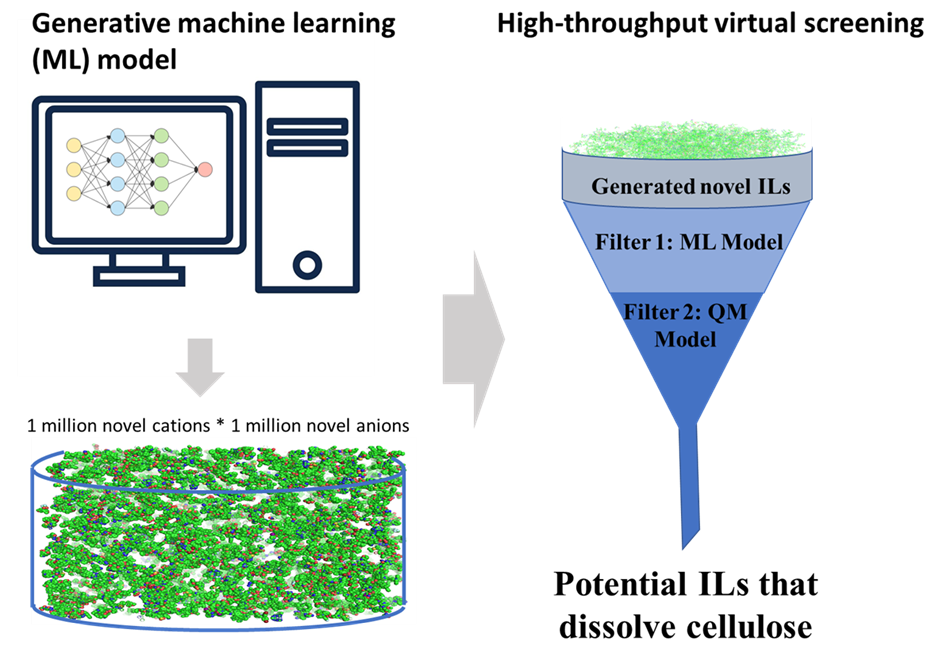
Figure: The workflow for the generation and
screening of novel ILs for cellulose dissolution
【Glossary】
*1 Monte Carlo Tree Search
A search algorithm based on the Monte Carlo method, widely used for decision‑making in game AI.
*2 Recurrent Neural Network
A type of neural network designed to process time‑series or sequential data.
*3Conductor‑like Screening Model for Real Solvents (COSMO-RS)
A computational method for evaluating intermolecular interactions in solution and predicting thermodynamic properties. Proposed by A. Klamt in 1995, it combines quantum chemistry and statistical mechanics to estimate properties such as solubility and activity coefficients with high accuracy.
Click here to see the press release.【Japanese only】
Journal : Journal of Cheminformatics
DOI: 10.1186/s13321-025-01018-z
Researcher Information : Kenji Takahashi
Sharma Gyanendra