

Scientists discover oral compound that helps “reset” the body clock forward-A potential breakthrough for jet lag and shift work-related sleep disorders
Mar 09, 2026
**The following content was written by the author of the paper.**
A Japanese research team has discovered a new compound that can advance the body’s internal clock—offering hope for faster recovery from jet lag and better adaptation to night-shift work. The compound, called Mic-628, specifically activates the transcription of a clock gene named Period1 (Per1). When given orally to mice, it advanced their body clocks and activity rhythms, regardless of dosing time. The findings suggest a new approach to controlling circadian rhythms through drug action rather than light exposure.
【Key findings】 A collaborative team including Emeritus Professor Tei H. (Kanazawa University), Associate Professor Takahata Y. (Osaka University), Professor Numano R. (Toyohashi University of Technology), and Associate Professor Uriu K. (Institute of Science Tokyo) discovered that Mic-628 selectively induces the mammalian clock gene Per1. Mic-628 works by binding to the repressor protein CRY1, promoting the formation of a CLOCK–BMAL1–CRY1–Mic-628 complex that activates Per1 transcription through a “dual E-box” DNA element. As a result, both the central clock in the brain’s suprachiasmatic nucleus (SCN) and peripheral clocks in tissues such as the lungs were advanced—in tandem and independent of dosing time. In a simulated jet lag mouse model (6-hour light-dark phase advance), a single oral dose of Mic-628 shortened re-entrainment time from seven days to four. Mathematical modeling revealed that the compound’s stable and unidirectional phase-advancing effect is mediated by a negative auto-regulatory feedback of the PER1 protein itself.
【Background and significance】 Adapting to eastward travel, such as west-to-east transmeridian flights, or to night-shift work requires advancing the internal clock, a process that normally takes longer and is physiologically harder than delaying it. Existing methods, such as light therapy or melatonin, are heavily constrained by timing and often yield inconsistent results. Mic-628’s consistent phase-advance effect, regardless of when it is administered, represents a new pharmacological strategy for resetting the circadian clock.
【What’s next?】 The researchers plan to investigate the safety and efficacy of Mic-628 in further animal and human studies. Because it reproducibly advances the body clock through a well-defined molecular mechanism, Mic-628 may serve as a prototype “smart drug” for managing jet lag, shift work-related sleep problems, and other circadian misalignment disorders. These results will be published in the Proceedings of the National Academy of Sciences of the United States of America (PNAS) in 2026.
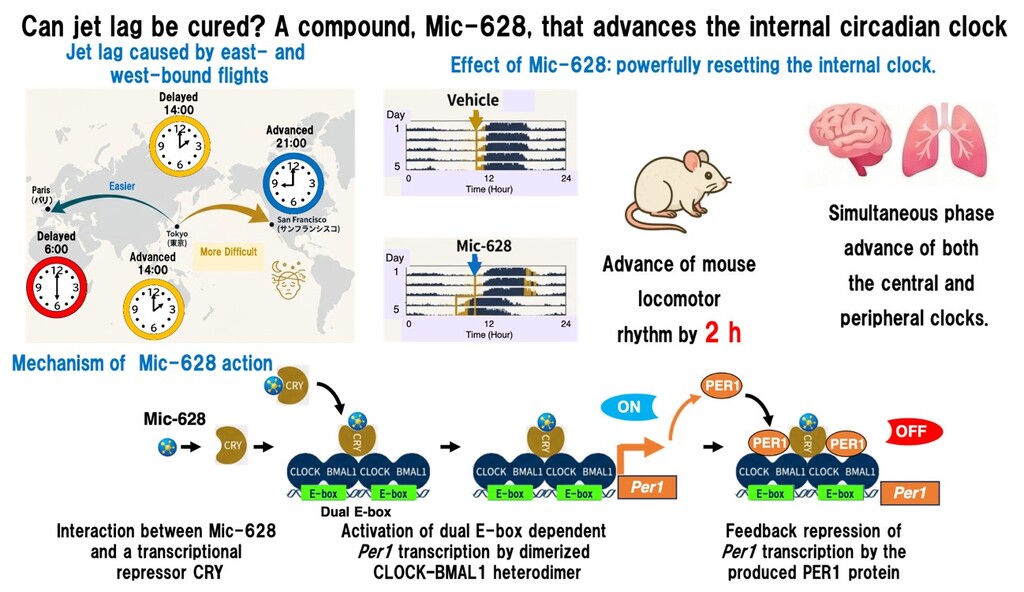
Figure: Mic-628-driven phase advances of the circadian rhythms.
(Upper left) Jet lag from international travel; (Upper right) Mic-628-inducedphase advances in behavioral, central, and peripheral circadian clocks; (bottom) Mic-628-CRY recruits CLOCK-BMAL1 dimer to dual E-boxes, inducing Period1.
Click here to see the press release【Japanese only】
Journal : Proceedings of the National Academy of Sciences of the United States of America (PNAS)
Researcher Information : Hajime Tei