

Emergence of “Left” and “Right” from Symmetric Molecules ―Spontaneous Hand-Holding of Molecules on a Gold Surface Creates Chiral Structures ―
Mar 31, 2026
*****The following content was written by the author(s) of the paper.*****
An international research team led by Prof. Yasuo Yoshida of Department of Physics, Kanazawa University, has discovered a mechanism by which left- and right-handed structures (chirality) emerge from molecules that are intrinsically symmetric. The study reveals that achiral molecules can spontaneously generate chirality by forming asymmetric pairs on a gold surface.
Chirality—the property that an object and its mirror image cannot be superimposed, like human left and right hands—is a fundamental concept in chemistry and plays a crucial role in determining the functions of pharmaceuticals and materials. Despite its importance, how chirality emerges at the most elementary level remains an open question.
In this study, the researchers focused on 1,10-phenanthroline, a molecule that is inherently achiral and possesses mirror symmetry. When adsorbed onto a gold surface, these molecules were found to spontaneously pair up, forming asymmetric dimers with distinct left-handed and right-handed configurations. In other words, the molecules “hold hands” on the surface, and this pairing alone is sufficient to break mirror symmetry and generate chirality. This finding demonstrates that chirality does not need to be encoded within an individual molecule from the outset. Instead, it can naturally arise through minimal cooperative interactions—in this case, the formation of molecular pairs on a surface. The results provide new insight into symmetry breaking at surfaces and offer a simple, intuitive pathway for the emergence of handedness from non-chiral building blocks.
Understanding such mechanisms opens new possibilities for designing surfaces and materials in which chirality can be generated and controlled on demand. This could lead to future advances in chiral materials, catalysis, and molecular nanotechnology.The research was conducted by an international collaboration including Kanazawa University, Kyushu University, Hokkaido University and Research Center for Quantum Physics, National Research and Innovation Agency (Indonesia).
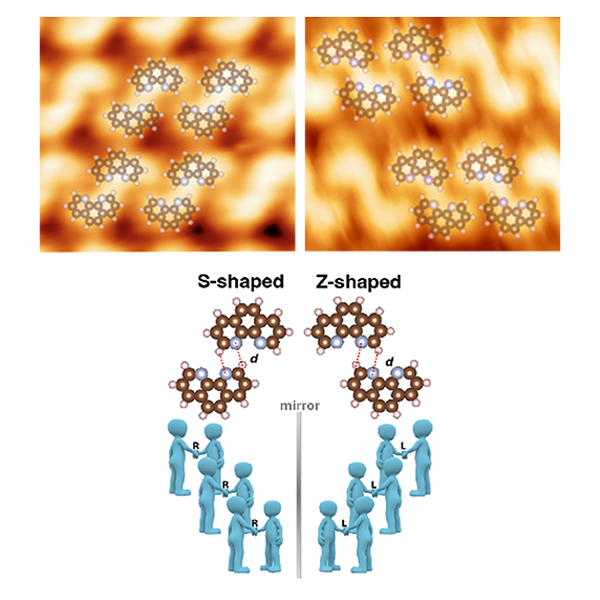 Figure: Scanning tunneling microscopy images of right and left-handed molecular pairs and the schematic descriptions.
Click here to see the press release【Japanese only】
Journal : Advanced Materials Interfaces
Researcher Information : Yasuo Yoshida