

A Black Hole “Blast Wave” Reaches 300,000 Light Years Away — Discovery of Energy Exceeding Expectations by More Than 100 Times —
Sep 11, 2026
A research team led by Specially Appointed Associate Professor Shutaro Ueda of the Advanced Space Science and Technology Research Center, Institute of Science and Engineering, Kanazawa University, has successfully conducted accurate measurements of the motions of the supermassive black hole at the center of a galaxy cluster — the largest and most massive astronomical objects in the Universe — and the surrounding hot gas, using X‑ray astronomy satellite XRISM(*), developed under Japanese leadership.
The team discovered that the hot gas blown out at high speed from the black hole—like a blast wave—is violently disturbing gas located far beyond its own galaxy (radius approx. 30,000 light years), reaching distances of about 300,000 light years. The energy of this blast exceeds previous estimates by more than 100 times, and the study is the first in the world to reveal that the influence of black hole winds, previously thought to be confined within galaxies, extends far into regions outside the galaxy, namely, the intergalactic space.
This research was made possible through collaboration between galaxy cluster and black hole researchers, who established a unique analysis method by drawing on the expertise of scientists deeply involved in the development of the XRISM satellite. Specially Appointed Associate Professor Ueda commented: “Observations of galaxy clusters with XRISM had been establishing a picture in which the influence of black hole winds was limited, and hot gas was moving quiescently. However, our results are completely unexpected. Understanding why only this galaxy cluster exhibits such a blast wave, and how the hot gas was violently disturbed, will be one of the next major challenges for XRISM, which has led astronomy through new discoveries.” Future observations with XRISM and next‑generation astronomical satellites are expected to further clarify how black holes affect their surrounding environments.
The results of this study were published in the scientific journal “Nature Astronomy“ at 10:00 a.m. (UK time) on July 28, 2026.
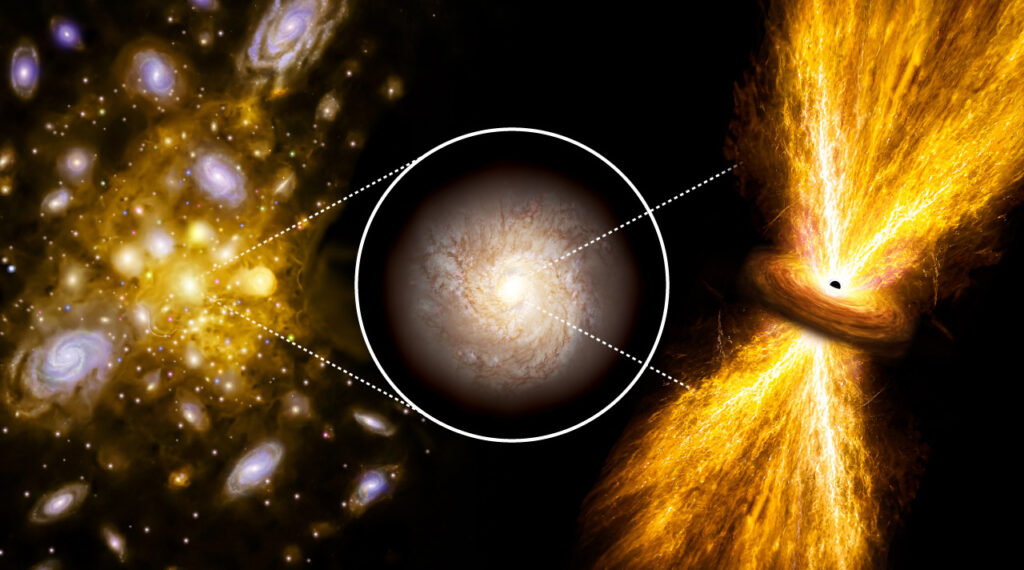
Figure: Schematic diagram of the hierarchical structure from a galaxy cluster (a group of galaxies) to a single galaxy and the supermassive black hole at its center. Although a black hole is more than 100 million times smaller than the radius of its host galaxy, it plays a crucial role at the galaxy’s center. (Credit: Tohoku University)
【Glossary】
* XRISM
The X‑Ray Imaging and Spectroscopy Mission (XRISM) is an X‑ray astronomy satellite launched in 2023 from the Tanegashima Space Center in Kagoshima Prefecture. Led by JAXA in collaboration with NASA and ESA, XRISM is an international joint project aimed at observing stars, galaxies, and the hot gas (plasma) flowing between them, to reveal—at unprecedented detail—the formation of large‑scale cosmic structures and the flow of elements and energy between celestial bodies.
Click here to see the press release【Japanese only】
Journal : Nature Astronomy
DOI:10.1038/s41550-026-02939-x
Researcher Information : Shutaro Ueda